


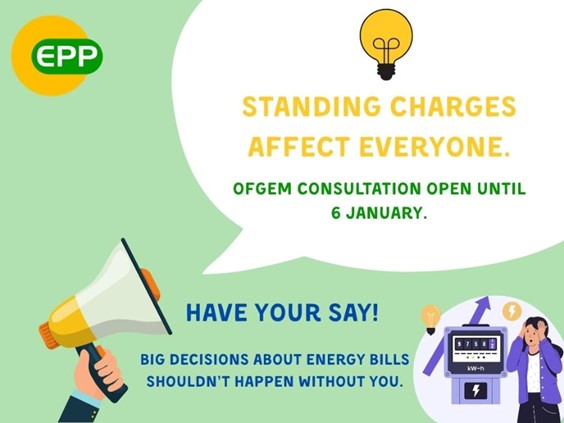
Standing charges are the daily payments chargeable to all energy meters, regardless of whether any energy is used. They are used to meet the fixed costs for distributing gas and electricity to our homes, and also include additional levies. One such levy is the “Warm Home Discount.”
OFGEM (Office For Gas and Electricity Markets) is the energy supply regulator in Great Britain. They are seeking views on the impacts on consumers of a proposal to move the Warm Home Discount costs from the standing charge to the unit rate (the per-kilowatt hour charge for electricity and gas usage).
The Warm Home Discount has been crucial in providing a de facto ‘social tariff’ through the primary activity of paying a discount of £150 to low income and/or vulnerable energy consumers. This year, the Warm Home Discount will be paid to significantly more households than last year, as government broadened the eligibility to include most billpayers in receipt of a means-tested benefit.
Many people don’t realise the Warm Home Discount also includes “Industry Initiatives” which allow the obligated energy suppliers to fund schemes designed to provide additional support to low income and/or vulnerable energy consumers. Some such schemes provide in-home energy advice for residents who might struggle to engage over the telephone. They can also provide routes to funds that could potentially reduce or totally clear energy debts.
Energy Projects Plus is pleased to deliver some schemes that are funded via the Warm Home Discount Industry Initiatives, and we agree that the mechanism to fund this vital work should be shifted away from the standing charges on everybody’s bills.
As standing charges have to be paid even if you don’t use any energy, each year we engage with multiple households who stopped topping-up their prepay gas meter once the weather picked up in March/April, only to find a debt on their meter when they wanted to turn their heating back on in September/October. They can’t afford to repay that debt, so without the support of our expert Energy Advisors, they would have no access to heat. It therefore feels like the right move would be to reduce how much the Standing Charge needs to be.
Standing charges can form a greater proportion of fuel poor households’ bills, and they’re often living in older, less energy efficient properties. This means that those households who receive the Warm Home Discount reduction payment, and support via Industry Initiatives, are themselves paying more than their fair share towards these schemes.
An alternative system would be for the Warm Home Discount to be paid out of general taxation. That way, our low-income, vulnerable clients experiencing fuel poverty are unlikely to contribute at all, as many of their incomes are below the threshold for Income Tax. But they could still benefit from the scheme. As part of OFGEM’s consultation, they welcome these ideas for how the system might change.
They’re keen to hear from you, whether you respond as part of an organisation, or as a private individual. Click the link below to take the online survey before the 6th of January.
If you’d like to discuss this survey before submitting your response, please feel free to contact us at info@epplus.org
Have your sayDeadline = 6th Jan 2026 |